
Ask five physicians which AI medical scribe is “the best,” and you’ll probably get five different answers, and honestly, none of them will be wrong. A scribe that’s perfect for a solo dermatology practice might fall apart the moment you drop it into a busy OB/GYN clinic. One built for English-only visits won’t help much in a community health center where half the patients need an interpreter, not just a transcriptionist.
So the real question isn’t “which scribe is best” in the abstract. It’s “best for what, exactly?” That’s the question worth actually answering.
The Problem With How Most Scribes Get Compared
Most comparisons online focus on one thing: how accurately the tool transcribes speech. That matters, but it’s honestly the easy part at this point — speech-to-text has gotten good almost everywhere. The gap between a mediocre AI scribe and a genuinely great one shows up somewhere else entirely: what happens after the words get captured.
A physician friend of mine, who runs a small family practice outside Sacramento, put it well during a call last year. “The transcript was never the problem,” she told me. “I could always get words on a page. What I couldn’t get was someone — or something — that understood what those words actually meant clinically, and then did something useful with that understanding.”
That distinction is really the whole story.
What Separates a Good AI Medical Scribe From a Great One
It documents, it doesn’t just transcribe. A basic tool writes down what was said. A strong one recognizes that “patient reports intermittent chest tightness, worse with exertion” needs to be structured, flagged, and coded differently than a casual mention of “feeling a little off.” That distinction is invisible in a transcript and critical in a chart.
It knows your specialty. A note built for a cardiology follow-up looks nothing like one for a pediatric well-check. Tools trained on generic conversation data tend to produce notes that need heavy editing before they’re usable — which defeats the purpose. The better ones are trained specialty by specialty, so the output already looks like something you’d have written yourself, for the visit you actually had.
It goes further than the note. This is where most scribes stop, and where the good ones keep going. Documentation that flows directly into coding, charge capture, and claims submission saves far more time than documentation alone ever could. A note finished quickly still leaves you with billing to do later. A note that becomes a submitted, accurate claim without extra steps is a different thing entirely.
It handles language barriers, not just accents. A scribe that struggles with a regional accent is a minor annoyance. A scribe that can’t function at all when a patient doesn’t speak English is a real gap in care — and one that shows up disproportionately in exactly the clinics that can least afford extra friction: rural practices, FQHCs, community health centers.
It’s actually HIPAA compliant, provably. Every vendor will say “secure.” Fewer can point to HIPAA compliance, ISO 27001 certification, and SOC 2 Type II audits as evidence, rather than a line on a marketing page. For anything touching patient conversations, that difference is worth checking before you sign anything.
What a Good Day Actually Looks Like
It’s worth picturing this concretely, because the difference is easier to feel than to describe in a features list.
A patient comes in for a follow-up. The physician talks, listens, and examines — nothing else. No laptop between them, no pause to type a sentence before moving to the next question. By the time the patient walks out, the note is already finished, coded correctly, and queued for billing. If that patient happened to speak Vietnamese instead of English, the conversation still happened in real time, just translated as it went, with nobody waiting on an interpreter’s schedule.
Multiply that by twenty or thirty visits a day, and the hours it saves aren’t abstract. They’re the difference between charting until 9pm and actually being home for dinner.
Questions Worth Asking Before You Choose One
Before committing to any AI medical scribe, a few questions tend to separate the tools that hold up from the ones that look good in a demo and fall apart in real use:
- Does it adapt to my specialty, or is it using one generic template for every visit type?
- Does documentation flow into coding and billing automatically, or does that work still land on my staff?
- Can it handle a visit in a language other than English, in real time, without extra scheduling?
- What certifications back up its security claims — not just a HIPAA mention, but actual audited compliance?
- How long does it realistically take my team to get comfortable using it?
If a vendor can’t answer those clearly, that’s usually the answer in itself.
Where HELIX Fits Into This
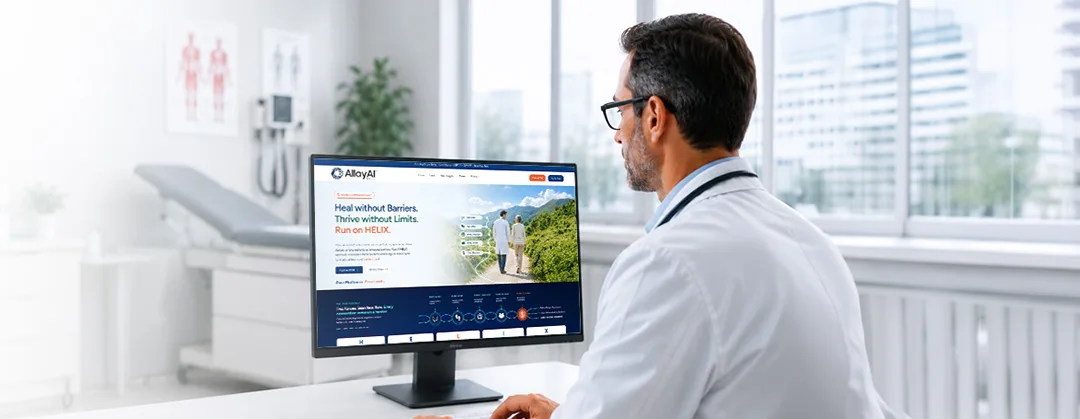
This is exactly the gap HELIX by AllayAI was built to close. It documents visits with specialty-specific accuracy, not generic transcription. It translates in real time across 190+ languages, so language is never the reason a visit gets harder than it needs to be. And it doesn’t stop at the note — coding, charge capture, and claims submission happen as part of the same connected system, backed by HIPAA compliance, ISO 27001 certification, and SOC 2 Type II audits.
There isn’t one universal “best” AI medical scribe. But there is a clear answer to what the best one actually does: it gives you back the parts of your day that never needed to belong to paperwork in the first place.
Curious what that looks like in your own practice? [Explore HELIX] or [Talk to an Expert] to see a real visit, start to finish.