
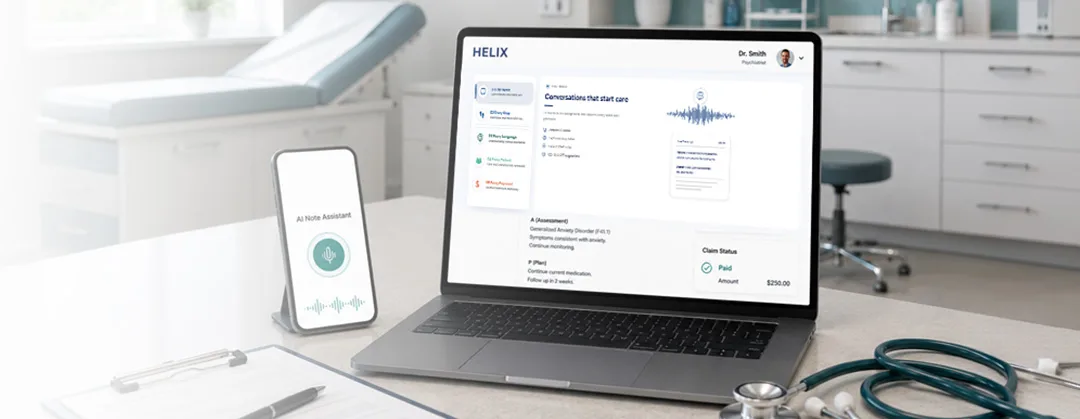
Healthcare Doesn’t Happen in Separate Steps
A patient walks into a medical practice with a problem.
The physician listens, asks questions, examines the patient, makes a clinical decision, and determines what should happen next.
But once the conversation begins, a much larger workflow starts moving in the background.
The visit needs to be documented. Orders or referrals may need to be handled. Prior authorization may be required. A patient may need follow-up. Information may need to move through an EHR. Documentation needs to support coding, and eventually the work needs to connect to claims and payment.
For many practices, these processes happen across multiple systems.
That creates a simple but important problem:
The patient experiences one visit, but the healthcare organization manages many disconnected workflows.
HELIX by AllayAI is designed around a different idea.
Instead of stopping at documentation, HELIX connects the patient journey from the first word to every payment, bringing clinical, operational, communication, and revenue workflows into one healthcare AI environment.
What Is HELIX?
HELIX is an ambient AI platform for healthcare designed to work in the background while clinicians focus on patient care.
The platform combines several capabilities, including:
- Ambient AI scribing
- Real-time translation
- EHR integration
- Patient portal capabilities
- Workflow automation
- Coding
- Claims and billing workflows
Rather than positioning AI as another application physicians have to constantly manage, HELIX is designed around the healthcare encounter itself.
The central concept is:
One Platform. Every Step of Care.
The HELIX Patient Journey
HELIX organizes its platform around five connected stages:
First Word → Every Step → Every Language → Every Patient → Every Payment
Each stage addresses a different barrier in the healthcare workflow.
1. First Word: Start With the Patient Conversation
Everything begins with the patient conversation.
Traditionally, physicians may need to divide their attention between listening to the patient and documenting the encounter.
HELIX’s ambient AI scribe is designed to listen in the background and capture the conversation.
The platform can then create structured clinical documentation, including instant SOAP notes and ICD-10 and CPT suggestions.
This creates a simpler workflow:
Conversation → AI captures → Information is structured → Clinical note is created
The physician can then review the documentation rather than building every part of the note from scratch.
This is where AI clinical documentation software can become more than a standalone note-taking tool—it can become the starting point for everything that happens next.
2. Every Step: Connect Clinical Workflow Automation
A clinical encounter creates more than a note.
Orders may need to be placed. Referrals may need to move forward. Prior authorizations may require attention. Care coordination and follow-ups may continue after the patient leaves.
HELIX is designed to automate and orchestrate these clinical and administrative workflows. Its listed capabilities include orders and referrals, prior authorizations, care coordination, and follow-ups and reminders.
This is where clinical workflow automation becomes important.
Instead of:
Task → Manual handoff → Another system → Manual follow-up
the goal is to create a more connected workflow where the next appropriate action can be triggered, routed, tracked, and completed.
HELIX describes this progression as:
Triggered → Routed → Tracked → Done
That approach can help reduce the need for staff to manually chase every step.
3. Every Language: Make Communication Part of Care
Healthcare communication can become more complicated when patients and clinicians don’t share the same preferred language.
HELIX includes real-time two-way translation designed to allow patients and clinicians to communicate naturally in supported languages. The current product page describes support for 100+ languages in one section and 190+ languages in another, so the exact current language count should be confirmed with AllayAI before publishing a specific number.
The important idea isn’t simply translation.
It’s keeping communication connected to the patient encounter.
The workflow becomes:
Patient speaks → Conversation is translated → Both sides understand → Care continues
For healthcare organizations serving multilingual communities, this can make communication part of the broader healthcare workflow rather than a completely separate process.
4. Every Patient: Bring Patient Context Together
A healthcare encounter doesn’t exist in isolation.
A patient’s history, previous interactions, care gaps, and other relevant information can influence the next clinical decision.
HELIX describes a unified patient context with a 360-degree patient view, history and interactions, care gaps and insights, and patient engagement.
The goal is to create continuity.
Instead of treating every appointment as an isolated event, the platform is designed to keep patient information connected throughout the journey.
For healthcare providers, this is an important part of modern healthcare operations software.
The technology should help the care team understand not only what is happening now, but also the context surrounding the patient.
5. Every Payment: Connect Documentation With Revenue
The final stage is where clinical work connects with the financial side of healthcare.
After documentation is completed, information may need to support coding and claims.
HELIX includes AI-powered coding, claims automation, denial prevention, and payment-related workflows.
The platform describes the progression as:
Coded → Claimed → Cleared → Paid
This is important because documentation and revenue cycle processes are not completely separate.
The quality and completeness of clinical documentation can affect what happens later in the workflow.
HELIX is designed to connect these stages instead of treating the clinical note as the final destination.
HELIX and EHR Integration
A healthcare AI platform needs to work within the systems a medical practice already uses.
HELIX’s product page describes EHR integration and says the platform works with major EHRs. The page also lists integrations involving EHRs, labs, PACS, pathology, CT, MRI, prescriptions, and pharmacy workflows.
This matters because physicians shouldn’t have to completely rebuild their workflow just to introduce AI.
The objective is to make AI fit into the practice.
Your existing workflow + AI assistance = a more connected healthcare experience.
Specific integration availability should be confirmed with AllayAI for each organization’s EHR and technical environment.
Why HELIX Is Different From a Standalone AI Scribe
AI medical scribes have become an important healthcare technology category.
But a scribe primarily solves one problem:
Documentation.
HELIX takes a broader approach.
Documentation is only the beginning.
The platform connects:
AI Scribe → Workflow Automation → Translation → Patient Context → Coding → Claims → Payment
This is why HELIX is positioned as an end-to-end healthcare platform rather than simply another medical transcription or scribing application. The product page explicitly describes it as an ambient AI platform that removes language, workflow, and billing barriers.
For practices looking for healthcare AI software, this distinction matters.
The question isn’t only:
“Can AI write my notes?”
It becomes:
“Can AI help connect the work that happens before, during, and after the patient visit?”
Built Around the People Who Use Healthcare Every Day
Technology should not make healthcare feel more complicated.
HELIX is designed for the people involved throughout the patient journey, including clinicians, front-office teams, billers, and patients.
The AllayAI website also describes HELIX as available across desktop, mobile, and EHR-integrated environments, with the goal of fitting into familiar workflows.
The broader objective is simple:
AI works in the background while healthcare professionals focus on care.
Security and Healthcare Data
Healthcare organizations need to consider security and privacy when evaluating any AI technology.
HELIX lists HIPAA compliance, ISO 27001 certification, and SOC 2 Type II, along with end-to-end encryption, role-based access, and continuous monitoring.
Organizations evaluating HELIX should still conduct their own vendor due diligence and request current compliance documentation, security materials, and applicable agreements before implementation.
The Future of Healthcare AI Is Connected
Healthcare technology has traditionally been organized around individual functions.
One system handles the EHR.
Another handles communication.
Another supports documentation.
Another handles billing.
But the patient’s experience isn’t divided into software categories.
It’s one continuous journey.
That is the opportunity for modern AI healthcare software.
Instead of adding another isolated tool, healthcare organizations can look for technology designed to connect the workflow.
HELIX represents this approach:
First Word
↓
Every Step
↓
Every Language
↓
Every Patient
↓
Every Payment
From the first conversation to the final payment, the objective is to remove barriers rather than create more of them.
Conclusion
The biggest opportunity for healthcare AI may not be creating another tool that performs one task.
It may be connecting the tasks that already exist.
HELIX is designed around this idea.
It starts with the patient conversation, assists with clinical documentation, moves into workflow automation, supports multilingual communication, keeps patient context connected, and continues through coding, claims, and payment workflows.
For U.S. physicians and healthcare organizations, the future of AI isn’t simply about doing more with technology.
It’s about making technology less visible, more connected, and more useful.
From the first word to every payment, HELIX is built to help healthcare work as one continuous journey.
Frequently Asked Questions
What is HELIX?
HELIX is an ambient AI platform for healthcare that listens during patient visits, assists with clinical documentation, and connects language, workflow, patient context, coding, claims, and payment-related processes.
How is HELIX different from an AI medical scribe?
A traditional AI medical scribe primarily focuses on clinical documentation. HELIX goes beyond the note by connecting documentation with workflow automation, real-time translation, patient context, coding, claims, and payment workflows.
Does HELIX support healthcare workflow automation?
Yes. HELIX includes automation for areas such as orders and referrals, prior authorizations, care coordination, and follow-ups and reminders.
Does HELIX integrate with EHR systems?
HELIX is designed to integrate with major EHR systems and fit into existing workflows. The exact integration path depends on the healthcare organization’s EHR and technical environment, so AllayAI should confirm compatibility for a specific practice.