
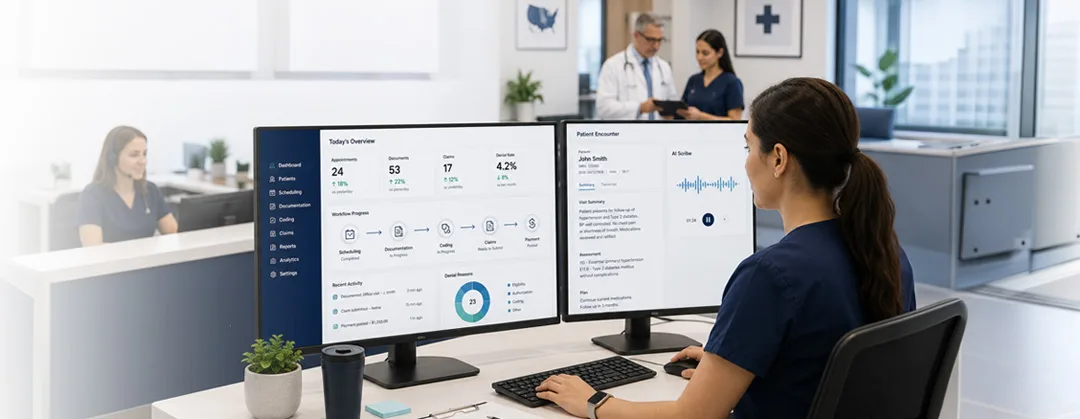
A physician’s work doesn’t end when the patient leaves the exam room.
After the conversation is over, there may still be clinical documentation to complete, orders and referrals to manage, prior authorizations to follow up on, patient communication to handle, coding to review, and claims to prepare.
When each of these activities happens in a separate system, the workflow can quickly become fragmented.
A staff member enters information in one place, moves it into another system, follows up with another team, and then repeats the process for the next patient.
This is where healthcare workflow automation can make a meaningful difference.
Instead of treating documentation, communication, administrative tasks, coding, and claims as completely separate activities, modern healthcare technology can connect these processes into a more continuous workflow.
For U.S. physicians and healthcare practices, the goal isn’t simply to automate everything. It’s to reduce unnecessary manual work while keeping clinicians and care teams in control of the decisions that matter.
That is the idea behind HELIX by AllayAI—an AI-powered healthcare platform designed to connect the patient journey from the first conversation through the work that follows.
What Is Healthcare Workflow Automation?
Healthcare workflow automation is the use of technology to organize, connect, and automate repetitive clinical and administrative tasks within a healthcare practice.
A traditional workflow might look like this:
Patient visit → Documentation → Manual follow-up → Coding → Claims → Payment
Each stage may involve a different person, system, or manual handoff.
An automated workflow aims to make the process more connected.
With the right technology, information captured during a patient encounter can help trigger or support the next stage of work without requiring staff to repeatedly re-enter the same information.
The objective isn’t to remove people from healthcare.
It is to remove unnecessary friction from the work people have to do.
Why Healthcare Practices Need Workflow Automation
Healthcare practices are responsible for much more than patient appointments.
Physicians need to focus on diagnosis, treatment, and patient communication. Administrative teams need to keep workflows moving. Billing teams need appropriate documentation and coding information. Patients need clear communication and timely follow-up.
When these responsibilities operate independently, small delays can accumulate.
For example, a physician may complete a visit but still need to finish documentation later. That documentation may then need to be reviewed before coding. Coding information may then need to move into claims workflows.
Every handoff creates another opportunity for information to be delayed, duplicated, or overlooked.
Healthcare workflow automation addresses this problem by connecting the stages that make up the patient journey.
The Five Connected Stages of HELIX
HELIX approaches healthcare workflow automation through a connected patient journey.
The platform describes this journey through five stages:
First Word → Every Step → Every Language → Every Patient → Every Payment
Each stage addresses a different part of the healthcare workflow while remaining connected to the broader encounter.
1. First Word: Start With the Patient Conversation
The workflow begins with the patient.
HELIX uses an ambient AI scribe to listen in the background during the encounter and capture clinical details. It can then create structured clinical documentation, including SOAP notes, with ICD-10 and CPT suggestions.
This is important because documentation is one of the first steps connecting the clinical encounter to everything that happens afterward.
Instead of a physician having to reconstruct the entire conversation after the appointment, AI-assisted documentation helps turn the encounter into structured information.
HELIX also states that its documentation workflow can work with existing EHR environments, helping connect the generated documentation with the systems practices already use.
The result is a more connected starting point for the rest of the workflow.
2. Every Step: Automate the Work That Follows
Documentation is only one part of a healthcare practice.
After a visit, additional tasks may need to move forward.
HELIX is designed to automate and orchestrate clinical and administrative workflows such as orders and referrals, prior authorizations, care coordination, and follow-ups and reminders.
This is where healthcare workflow automation becomes particularly useful.
Instead of relying on staff to manually remember every next step, the platform is designed to help move tasks through the workflow.
The goal is simple:
Less manual chasing. More connected work.
3. Every Language: Keep Communication Connected
Healthcare communication can become more complicated when patients and clinicians don’t share the same preferred language.
HELIX includes real-time two-way translation designed to allow patients and clinicians to communicate naturally in supported languages. The current HELIX page lists 100+ languages in one section and a broader 190+ figure elsewhere, so AllayAI should standardize this claim across its website before publishing marketing copy.
The separate HELIX Translation page describes real-time medical translation and automatic English clinical documentation, reinforcing the connection between communication and documentation.
This means translation doesn’t have to be treated as an isolated activity.
It can become part of the same connected healthcare workflow.
4. Every Patient: Keep Patient Context Connected
Good healthcare requires context.
A physician shouldn’t have to reconstruct a patient’s story from disconnected pieces of information every time the patient returns.
HELIX provides a unified patient context that includes areas such as history, interactions, care gaps, insights, and patient engagement.
The purpose is to help healthcare teams work from a more connected view of the patient.
This is an important part of healthcare workflow automation because automation isn’t only about completing tasks faster.
It is also about making sure information reaches the right stage of care at the right time.
5. Every Payment: Connect Documentation to Revenue Workflows
The final stage of the HELIX journey connects clinical documentation with coding and claims workflows.
HELIX provides AI-powered coding support, claims automation, denial prevention, and payment workflow capabilities. The platform also provides ICD-10 and CPT suggestions from documented visits.
This creates a more continuous path:
Clinical encounter → Documentation → Coding → Claims → Payment
For a healthcare practice, this connection matters because administrative work doesn’t stop when the clinical note is complete.
The information generated during the encounter can continue supporting downstream workflows.
How to Start Using HELIX
If you’re a physician or healthcare practice considering healthcare workflow automation, the first step is understanding where your current workflow has the most friction.
Start by identifying where your team spends unnecessary time.
Is documentation taking too long?
Are staff manually moving information between systems?
Are follow-ups difficult to track?
Are coding and documentation disconnected?
Are language barriers making patient communication more difficult?
Once you understand those bottlenecks, you can evaluate how HELIX fits into your existing workflow.
The current AllayAI site presents HELIX as available across desktop, mobile, and EHR-integrated environments, with a focus on familiar workflows and rapid adoption.
You can learn more about the platform on the official HELIX product page. Explore HELIX
How to Download and Use the AllayAI App
For clinicians who want to use AllayAI on a mobile device, the AllayAI app is available through both Apple and Google app stores.
The official Apple App Store listing identifies AllayAI as a medical app from AllayAI Inc. and describes features including medical AI scribing, secure chat, real-time two-way translation, and clinical documentation.
Download AllayAI from the Apple App Store
The official Google Play listing also provides the AllayAI Android app, with secure chat, real-time translation, and documentation capabilities.
Download AllayAI from Google Play
AllayAI’s own how-to page explains that the platform is cloud-based, allowing users to access their information across devices after signing in. It also provides guidance on capturing visits, editing notes, copying notes to an EHR, dictation, and other workflows.
For organizations evaluating HELIX specifically, the best starting point is the HELIX product page and a conversation with the AllayAI team about your existing systems and workflow requirements.
What Makes Healthcare Workflow Automation Different From Simple AI Tools?
There is an important difference between automating one healthcare task and connecting the entire workflow.
A standalone AI tool might help create a clinical note.
That’s useful.
But the broader opportunity comes when the information created during that encounter can support the next stages of work.
HELIX is designed around this connected approach.
Documentation connects to coding.
Workflow tasks connect to care coordination.
Translation connects to communication.
Patient context connects to the encounter.
Coding connects to claims.
The result is a platform designed around the entire patient journey rather than one isolated administrative task.
How to Evaluate Healthcare Workflow Automation Software
Before choosing a solution, healthcare practices should look beyond the word “AI.”
The right platform should fit the actual workflow of the organization.
Look at the Clinical Workflow
Consider whether the software supports the way physicians and care teams already work rather than creating another disconnected process.
Evaluate EHR Connectivity
Existing EHR systems are central to many healthcare practices. HELIX states that it is designed to work with major EHRs and can fit into existing workflows.
Consider the Full Patient Journey
A platform that addresses only documentation may solve one problem while leaving the rest of the workflow unchanged.
Look for technology that can connect documentation, tasks, communication, patient context, coding, and claims where appropriate.
Review Security and Compliance
Healthcare organizations need to take patient information security seriously.
The HELIX page lists HIPAA compliance, ISO 27001, and SOC 2 Type II among its security and compliance claims, along with end-to-end encryption, role-based access, and continuous monitoring. Organizations should request current certification and compliance documentation directly from AllayAI during evaluation.
The Future of Healthcare Workflow Automation
Healthcare automation is moving beyond individual tools.
The next stage is connected intelligence—technology that can understand what happened during an encounter and help move the resulting information through the appropriate workflow.
For physicians, that can mean less time spent managing disconnected administrative processes.
For healthcare teams, it can mean fewer manual handoffs.
For patients, it can mean a more connected experience.
And for practices, it can create a clearer path from the patient encounter to the administrative and financial work that follows.
That is the larger promise of healthcare workflow automation.
Not replacing healthcare professionals.
Not automating for the sake of automation.
But creating technology that quietly handles more of the repetitive work so healthcare professionals can focus on the work that requires them.
Frequently Asked Questions
What is healthcare workflow automation?
Healthcare workflow automation uses technology to connect and automate repetitive clinical and administrative processes. These can include documentation, orders, referrals, prior authorizations, care coordination, follow-ups, coding, claims, and other workflow steps.
How does HELIX automate healthcare workflows?
HELIX connects several stages of the patient journey, including ambient clinical documentation, workflow automation, real-time translation, patient context, coding, claims, and payment workflows. It is designed to reduce unnecessary manual handoffs between these stages.
Can physicians use AllayAI on a phone?
Yes. AllayAI has official apps available through the Apple App Store and Google Play. The App Store listing describes the app as providing medical AI scribing, secure chat, real-time two-way translation, and clinical documentation.
Is HELIX compatible with existing EHR systems?
HELIX states that it is designed to work with major EHRs and fit into existing workflows. For a specific EHR, AllayAI recommends contacting its team to confirm the available integration path.
Conclusion
For U.S. healthcare practices, workflow problems rarely come from one single task.
They come from the spaces between tasks.
A physician finishes the visit, but documentation remains. Documentation is complete, but coding still needs attention. Coding is finished, but claims still need to move forward. A patient needs follow-up, but someone has to remember to make it happen.
Healthcare workflow automation addresses those connections.
HELIX by AllayAI takes this approach by connecting clinical documentation, workflow automation, multilingual communication, patient context, coding, claims, and other parts of the patient journey within one healthcare platform.
For practices considering their next step, the question isn’t simply whether AI can perform one task.
The better question is:
Can your technology connect the work that happens before, during, and after every patient encounter?
That’s where healthcare workflow automation can move from a technology concept to a practical part of modern clinical operations.
Explore HELIX and see how a connected healthcare workflow can work for your practice.